Monday, October 31, 2016

The Gang takes on Magnolia Cemetery!


The Pyramid at Magnolia Cemetery
THIS IS IT! The blog post everyone was waiting for, a trip to the grand Magnolia Cemetery. This Cemetery is unlike any that I have visited. The beautiful scenery, almost made me forget that the dead was buried there. Its atmosphere holds a historical sense to it. While exploring the massive landscape, I ran into a pyramid in the south, a beautiful lake, and a tribute to the confederate soldiers. Stay tune and remember to bring bug spray.

Opened in 1850, Magnolia Cemetery contains 150 acres of land, and is a eternal resting place to over 35,000 people. The land is well kept, and it has a beautiful bridge over a wide lake. There are hundreds of different pathways to travel on and make your own little

It was difficult to choose 3 out of 35,000 masterpiece, but one of my all time favorite is the grand monument dedicated to Elbert P. Jones. He was born in Kentucky on September 23, 1814, and it says that he died in Charleston on April 1, 1892. It is also stated on the monument that Jones was a resident of San Francisco, California for the last six years of his life.
A tribute to Elbert P. Jones 

The top of the monument is a masterpiece, it is a sculpture of what is present in many catholic churches. It even has its own iron gate surrounding the monument. The wife of Jones did an excellent job of creating a tribute to her husband, the first words written are " A tribute of affection to a beloved husband".

Next is the elaborate family section dedicated to the Revel family. The section is surrounded by stone, and at the entrance is a very detailed gate. What really drew my attention toward the Revel's burial site, was the statue placed in the center. The statue depicts a women (maybe Jesus' mother, Mary) holding onto to the cross, with a crown flower in her hand.
The Revels' family burial site
The Statue itself is dedicated to Ellen and Mathew Revel. Ellen died on February 27, 1899, at the age of 65. Mathew died on January 15, 1906, at the age of 80. written at the bottom is "In life I loved thee, in death I mourn thee."

To add to the historic atmosphere of Magnolia, it is a resting place for 2,200 confederate veterans. It even has a section dedicated to the fallen soldiers. So in honor of this, the last monument that sparked my interest was one dedicated to James Brown Boyd.

Boyd was in the Palmetto Guards. He was in 2nd S.C regt Sergeant who died during the battle of Sharpburg, in Maryland on September 17th, 1862. With a confederate flag placed in the ground in front of the small monument. At the top is stoned vase full of flowers. It signify the grief of the loss of a great Sergeant.  


A tribute to Sergt. James Brown Boyd

 Overall, the trip to Magnolia was one for the books! It was an amazing experience, and who knew that so much is within a cemetery. It was a beautiful view and I would encourage other to take a stroll through Magnolia, bring friends, and lots of bug spray!

The lake at Magnolia
Cemetery


Sunday, October 23, 2016

Symbolism in its deadly.

Bethel United Methodist Church, located downtown Charleston, is a resting place for over 500 souls.
 In 1792, the church was special, because it served both blacks and whites. There are even enslaved and free slaves buried in the graveyard. But sadly,, most of the headstones are cracked due to natural and man made offensives. Here are just a few of the mysterious, yet beautiful crafted symbols on the headstones.

This neat and well sculpture, head stone belongs to Rosa Mary,
She was on born October 9th 1835, and died on November 2nd 1881.The drape signfies mournig of the family, and the flowers mean grief,

The next head stone belongs to Olin B, Davis. There is another arrangement of flowers, instead this one is of roses. Roses could of been Olin's favorite flower, or it could also is a sign of the families grief of the lost of Olin Davis.


The ledger stone belongs to Lousia M. Reeder. With the words across the top with "Our mother". The reef under the words, signify the how much her children appreciated her as their mother or how she served an important role in others' lives.


Joseph W. Ainger's headstone is one of several, that are laid up against the wall of the church. With the words "Our Brother" above his name. At the top. is a sophisticated crown with a cross inside. This symbol appears on many headstones. According to Patrick Harwood , in his book The Arms of Angles Magnolia Cemetery, the symbol means " suffering (the cross) followed by eternal reward (the crown)" (159).


A head stones down from Jospeh Ainger's, is his mother Elizabeth M. Ainger. Born on October 14th 1807, and died on October 6th 1872. In the same design, except, the arrangement of flowers and the dove about it. The flowers still signify the grief of the family, but the dove also signifies how at peace they are under the somber circumstances.


 Another head stone that is laid against the wall, is the head stone of James F. Lobd. It is beautifully crafted, with the detail of a weeping willow tree. The tree symbolizes growth and harmony.

The ledger stone of a small child by the name of Seth
Piror, is surrounded by the ledger stone of his family. What is unique
about Seth's ledger stone, is a lamb, which looks to be on a marble slate.
This could mean how innocent he was, since he died at the young age
of 3. A lamb ready for his master to claim him, in his humble state.


One of the beautiful symbol is the one belonging to Mary Cruiskant. Unfortunately, Mary's elaborate headstone is cracked, and is hidden in the parking lot. But the detailed craved potrait of the missing women speaks for itself, The font that her name matches the photo. The grief of Mary's family is the proof on her tombstone.
The last, sadly, head stone belongs to Thammis Smalls. The dark exterior around this symbols adds to the symbol. It appears to be angle wings with an hour glass in the center, and ax going through it,This symbol could been that family thought Thammis was an angle and that his time was set in stone.

Monday, October 3, 2016

Let me introduce ya'll to my great grandma: Marie Bradshaw Wright

Marie Bradshaw Wright. Holding my eldest sister, Rosalind Ramirez
 Marie Bradshaw Wright. She was born on September 10th, 1910, and she lived a pretty normal life for an African American young women during this time. She was born in raised on the outskirts of a small town called Bishopvile in South Carolina.

She grew up in a small house on Eden street with her parents, and her four siblings (two boys, two girls). Marie was the baby of the family, and she attended school up until the eighth grade. She grew up during segregation, and attended a small one room school with one big boy wood heater.

After school, young Maria did not play with toys or even do homework. Instead she changed out of her school clothes, put on her field clothes, and ether pick or hold the cotton depending on the season.  At the end of the day, her father would collect all the cotton the family picked, present it the foremen who would then weigh the cotton and record it. The cotton was worth only one or two cent a pound.

Entering the early ages of her adulthood, she married a young sol
ider who served in World War II named James Roberson Sr, and they had one son together, named James Roberson Jr. The two were not married long, due to James being murder. Later, she married a John Wright Jr and together they had three boys and two girls.

Marie, in addition to picking cotton, she also became a maid working in a "big house", and only made $25 a week. During the last few years of her life, Marie and John were well known throughout the town as the first black family to own a car, a T.V, and a house phone. She raised two of her grandchildren, making it a total of six people living under one roof. After John passed away in March of 1989, Marie passed away in June of the same year. The cause of her death, according to doctors, was a broken heart from her one true love.


Sunday, September 25, 2016

A Trip to the Grave

A Class picture at the Cathedral Church of St. Luke 
 During an impressive visit to two of downtown Charleston's graveyards, I am captivated by the hidden beauty and mystery of a graveyard. Yes, I know it is a little weird, but I promise it is not as bad as it seem!

Edward Rutledge Lohndes' headstone
with a message saying " hear what the
voice from heaven declares to those who
die, released from all their earthly cares
they reign with him on high." 
This drew my attention right away when I saw how tall and pronounce it stands. It seems to have three steps to the headstone and it gives an effect of being higher then the rest. This headstone belongs to a Edward Rutledge Lohndes. He died on the 24th of March, 1853, and it is stated that he was 43 years of age and 3 months. Located at the Cathedral Church of St.Luke, it has a message stating " Blessed are the dead who die in the Lord."

A headstone dedicated to the Reeves family
This Memorial was a little confusing upon first glance. It is dedicated the the Reeves family. The first name is Matthew Sully Reeves who was born in 1814, and died in the year of 1862. Then they mention an Ellen Jackson, who biological father was  a man named Edward Bounetheau (also mentioned on the tomb stone). Then the last name is Martha Bounetheau who was the wife of Matthew Reeves. Confusing I know, but it raises a lot of questions as to why Martha and her daughter did not gain the Reeves last name.

This obelisk column stand in an open area and also stands a good height off the ground. There are three cement slabs that layer up to hold the column up. Although the slabs seem to have some weather damage, the column still is beautiful. Although no names or dates are located on the column, it do have the words "Our father and mother."
Cradle grave of Eliza Simons.

The tall obelisk column is beautiful white
comparison to the dark background.

The cradle grave of Eliza Simons is mother to Dr. J, Hume Simons. It has the words "Our mother" is stretched across the top, although only Dr.Simon is mentioned on the stone. it states that Eliza was born May 20th, 1823 and died on March 1897.

Another item of interest, is this beautiful cross monument, There is a smaller cross on the printed on the cross with a crown around it. This can be symbolic to the everlasting life after death in Christianity. This grave site belongs to a Harriet and John Nowell.

Cross monument dedicated to Harriet and
John Nowell 
Just because something is small and simple does not mean it does not serve it's purpose in a big way! This small ledger stone is dedicated to Julia who was born on November 29, 1797 and died on April 27, 1842.

the crafted rose on the gravemaker.
This beautiful crafted symbol of a single rose surrounded by an arrange of leaves on a vine. There also seem to be a less , bigger rose on the side, this could symbolize an hidden beauty.


A sophisticated coral leaf arrangement with a ribbon signify a grand life liven. below are the words "Elizabeth B.Noble,"

This grand Mausoleum is surrounded by a black iron gate, With a Latin description across the top. On either side of the door stand two large upturned torches.This could mean a person's passion ended. Or an ambiguous person is buried here.
the elaborate reef. 
an elaborate craving of the "sleeping
beauty"

The grand Mausoleum with the Latin
words "OVI CHRISTO VIVI
PERIRE NESCIT."
Now this headstone had a grand carver. The detail of a young women laying down on a stone bed is remarkable. The design is very neat and dark areas really do make the women pop out. This is symbolic for the women who died is merely sleeping. 
the small ledger stone dedicated to Julia.With
the words "He giveth his beloved son."

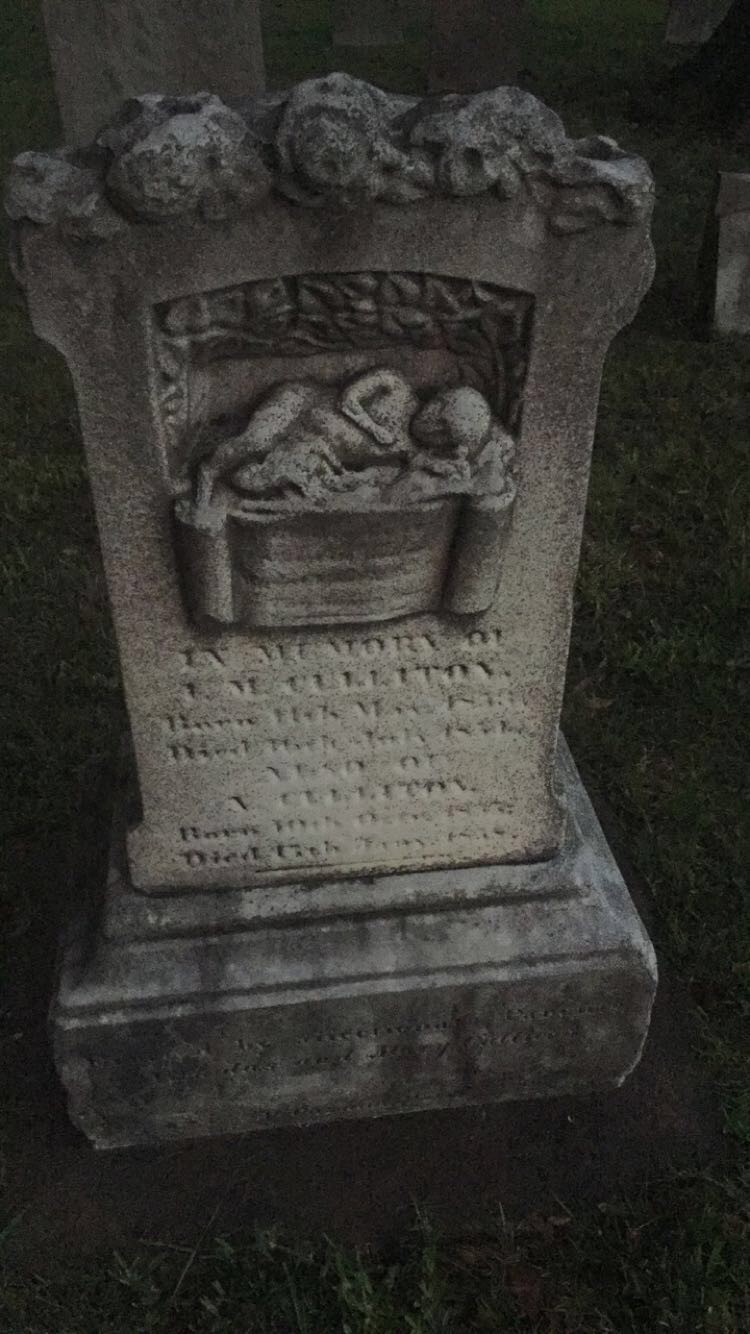
Another creative headstone in the graveyard of St. Patrick Catholic Church. The stone has horns sticking out each top corner. On the top half, their is a picture of weeping willow trees, covering what looks to be a bull on a marble slate. This can symbolize an offering to God, like in the New Testament of the Bible.
The beautiful picture of the sacrificial bull. 
   

Monday, September 19, 2016

A step into a Grave, is a step into the past: Ruth Miller's Experience and Knowledge

Mrs.Ruth Miller (left) and Professor Harwood
as he gives a copy of his book to Mrs.Miller
Ruth Miller began her journey into becoming a phophile, after an unexpected tour through a graveyard. She was leading a group of tourist through downtown Charleston, when one of the tourist asked if they could get a tour of a graveyard. Ever since, Mrs. Miller became interested in the hidden beauty of graveyards.

Mrs.Miller is a local expert and an author, who spoke about the history behind many graveyards in Charleston. Which holds a lot of interesting characters and their tombstone is a reflection of their life. Now what makes old Charleston so interesting?  She tells us that in 1776, Charleston had more money than New York, and Boston. This is very fascinating because that was the same year that the United states was created.

A book that Mrs.Miller brought in that goes into
details of early gravestones. written by
Diana Williams combs
St. Mary Church’s graveyard is filled with headstones with the ending year 1838. This is due to the outbreak of yellow fever and it killed thousands during this time. A pastor held a sermon saying that the source of the yellow fever came from the drinking and sharing of alcohol (Ruth Miller).  People migrated from place to place during this time to avoid the deadly illness. Mrs.Miller stated “One of the clues that it was time to move north when the frogs started croaking.” The frogs would indicate that it was the beginning of summer, and time to migrate again.
Peale's painting "Rachel Weeping" shows his wife
mourning over her deceased daughter. 

“1/3 by 8 years old, a third is dead by 18 and after 18 you live forever” stated Mrs. Miller as she tried to explain the short life expectancy of the people of the 18th century. So many graves from that time are little babies due to their poor immune systems to fight off the illness that plagued this time. The daughter of famous portrait painter Charles Wilson Peale died in 1772 of smallpox. Peale painted a portrait of his wife crying over the dead body of her daughter.
Although graveyards hold a somber atmosphere, people like Mrs. Miller find the beauty and historic meaning behind them. “Churches everywhere show the value of the architect” says Mrs. Miller. Churches of the 18th century reflects the culture of the time, and it shows how much time and dedication they put into building not only the church but the tombstones themselves. Many of the unpopular religions of the time, leaves little traces of them being here. 

For example, 17th century Judaism at the time was not as large as it is today, so many of their grave sites are modern day parking lots. "the unheard and unpopular gets plowed and covered up" said Mrs. Miller as she talked about how other religions such as the Quakers, suffered the same way.Mrs. Miller opened her mind and heart to the history of Charleston's graveyards.

She spoke about the famous and about the average men and women who lives all mattered in the end, regardless of how short it was. Her love for the architect is strong, and it shown across her face as she introduced me into a new way of looking at a sad place that is really a beautiful 

Tuesday, September 13, 2016

Hey Friends!


This is my two sister and I. Donnetta
on the left, Rosalind, and me on
Halloween last year.
Hey ya’ll! My name is Tomeka Adams, I am from Sumter, South Carolina (two hours away) and I live with my beautiful dramatic mom. I have two older sisters. Donnetta and Rosalind. We are pretty close and I truly admire them.They have also blessed me with 8 nieces and nephews. Note the sarcasm.

I don't know if i want a degree in nursing or to go to P.A school. What I do know is that I want to get a degree in the medical field. I have a group of friends back home that really inspire me to be the me I can be! I was a girl scout from 3rd grade up until I graduated high school. So if you need girl scout cookies I’m ya girl!!! I graduated from Sumter High School in 2016,and I became involved in my Sumter Young Life group, a christian organization just for High school students.
My friend Sarah Catherine and I at
at a Sumter high football game. Go Gamecocks

So far I like being a college student. I enjoy the good vibe that College of Charleston gives off. It is also amazing I am able to take such an interesting FYE class. This course is something that I have never heard before, and I am very interested in the teachings of it. I really hope we have a great semester in this class and that it will open my mind up to the different things the 
world has to offer.
Me and my Young life group on a camping trip!